A New Hampshire House Candidate Pitched DPC as Affordable Care. Her Opponent Voted Against the Law That Opened HSAs to It.
At a Greater Nashua Chamber forum, Republican Lily Tang Williams called direct primary care affordable and local. Rep. Maggie Goodlander attacked H.R. 1, the law that let HSA money pay DPC fees. The local paper's account doesn't show either one linking the two.
Policy Desk 5 min read Legislation

Lily Tang Williams wants voters in New Hampshire’s 2nd District to think about direct primary care. “It’s very affordable and it’s local,” the Republican challenger said at a Greater Nashua Chamber of Commerce forum on Oct. 19, according to The Cabinet Press.
Rep. Maggie Goodlander, the Democrat she’s challenging in a rematch of their 2024 race, turned in her health care remarks to a different subject: H.R. 1. “It has triggered the biggest cuts to Medicare in American history,” she said, per the same report. The paper’s account of her remarks says the law is expected to cut federal health insurance by $880 billion by 2034 and put 15 million Americans at risk of losing coverage.
The paper’s account doesn’t show either candidate connecting the two. H.R. 1 is the law that changed how DPC works with health savings accounts. Goodlander voted against it.
The law in the middle of the room
H.R. 1 became Public Law 119-21 on July 4, 2025. Section 71308, titled “Treatment of direct primary care service arrangements,” says a qualifying DPC arrangement “shall not be treated as a health plan” for HSA purposes. Before that, the IRS says, an individual enrolled in a DPC arrangement generally wasn’t eligible to contribute to an HSA, because the membership counted as a health plan paying before the deductible.
The House passed the final version 218 to 214 on July 3, 2025. Goodlander’s recorded vote was No.
The IRS spelled out the mechanics in Notice 2026-5. The provision applies to months beginning after Dec. 31, 2025. The law also exempts DPC fees from the general rule that an HSA may not be used to pay for insurance, so the account can pay them.
There’s a ceiling. An arrangement only keeps a patient’s HSA contribution eligibility while the aggregate DPC fees stay at or under $150 a month, or $300 for an arrangement covering more than one person. The limit adjusts for inflation after 2026.
A fee above the cap doesn’t stop the HSA from paying it. Answer 20 of the notice says those fees are still reimbursable medical expenses. What the patient loses is the right to put new money into the HSA while enrolled.
So a Republican candidate praising DPC’s affordability is praising, in part, a change her opponent voted against. And a Democrat warning about H.R. 1’s coverage cuts is attacking the same bill that gave DPC members a tax-advantaged way to pay. Both candidates’ subjects run through the same statute. The forum coverage doesn’t show either one saying so.
The price range in the coverage
The Cabinet’s report added context after Tang Williams’s quote: “According to the American Academy of Family Physicians, the cost of individual monthly memberships range from $20 to $150.”
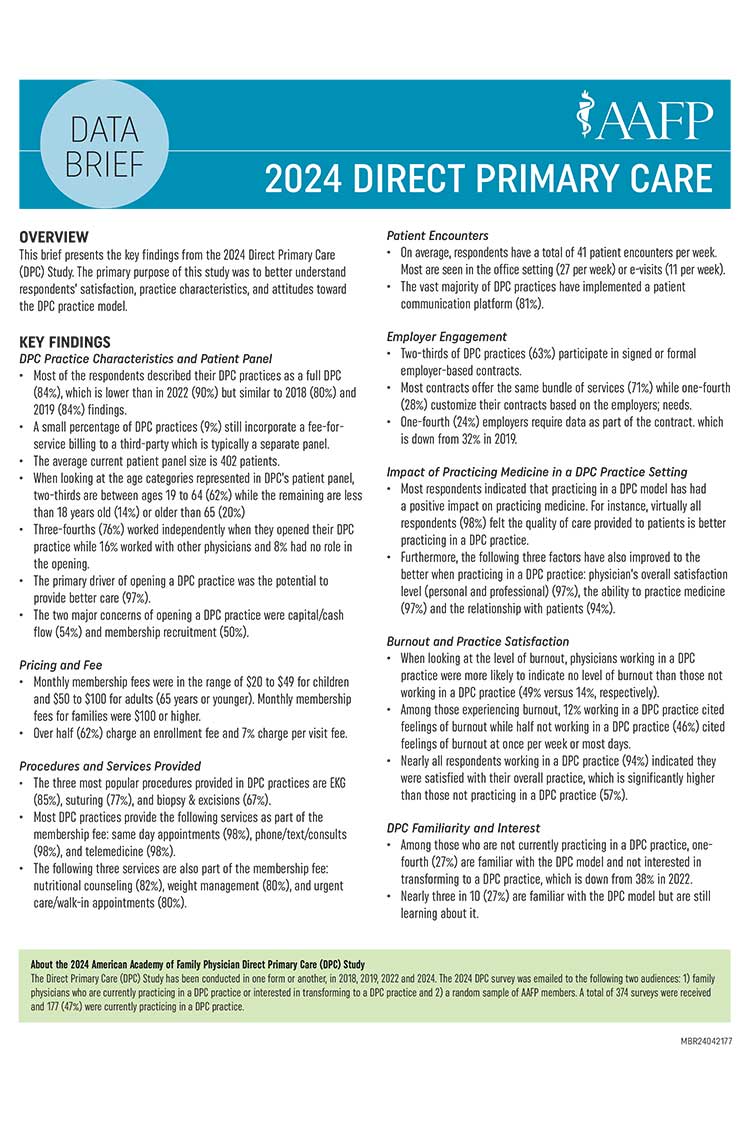
AAFP’s main DPC page gives a different range. It says monthly membership fees “generally range from $50 to $100.” Its 2024 data brief breaks that out: $20 to $49 for children and $50 to $100 for adults 65 or younger, with family fees at $100 or higher. That brief rests on a survey with 374 responses, 177 of them from physicians practicing DPC.
The $20 matches the brief’s floor for children. Neither AAFP document gives $150 as the top of an individual range. Prices vary by practice, and a New Hampshire practice sets its own.
The $150 figure does appear in federal law, as the HSA contribution ceiling above. That’s a different number doing a different job.
New Hampshire already wrote its rules
The state settled DPC’s legal status seven years ago. RSA 329:1-e, effective Oct. 15, 2019, says DPC services under a qualifying agreement are “not insurance” and that the provider isn’t subject to the requirements of RSA 415 and RSA 420, two state insurance chapters, or to the commissioner’s jurisdiction.
The conditions are specific. The agreement has to be in writing and list the periodic fee. The patient has to be able to end it on no more than 90 days’ notice. It must state prominently that it isn’t health insurance and that the provider won’t file claims against the patient’s insurance for services the fee covers.
The statute also says a DPC practice “shall not decline to accept new direct primary care patients solely because of the patient’s health status.”
That leaves a member of Congress with less to do on DPC than the campaign line suggests. The state framework exists. The HSA change is law. The Cabinet’s report doesn’t describe any further federal DPC proposal from Tang Williams.
Where DPC fits in Goodlander’s argument
Goodlander’s subject is people losing coverage. The Cabinet’s report puts the number of Nashua residents who rely on federal government health insurance at 16,778. She also praised the region’s community health centers, naming Lamprey Health Care and the Greater Nashua Mental Health Center.
A DPC membership answers a narrower question. New Hampshire’s own statute makes the practice say, in writing, that the agreement isn’t health insurance. AAFP notes that because some services fall outside the retainer, DPC practices often suggest patients carry a high-deductible wrap-around policy for emergencies.
The HSA change has the same boundary. Under Notice 2026-5, an individual has to be covered by a high-deductible health plan to contribute to an HSA. Someone who just lost that coverage can’t add new money to the account.
For a patient in that position, a membership can pay for primary care, and emergencies fall outside it. That’s a real benefit for some patients, and it’s a different answer from the one Goodlander is asking about. Voters in the 2nd District will pick between the two framings on Nov. 3.
Sources
- Goodlander and Tang Williams share views on range of topics
- Public Law 119-21 (H.R. 1), Sec. 71308, Treatment of direct primary care service arrangements
- Roll Call 190, H.R. 1, On Motion to Concur in the Senate Amendment, July 3, 2025
- IRS Notice 2026-5, Health Savings Accounts under the One, Big, Beautiful Bill Act
- AAFP, Direct primary care: What to know
- AAFP 2024 Direct Primary Care Data Brief
- N.H. RSA 329:1-e, Direct Primary Care